 Patients
 Doctors
Assessment and CPR
It consists of the exploration of vital signs with the sole purpose of detecting their presence, without entertaining ourselves in quantifying them. It will always be done quickly and systematically , following these steps:
- CONSCIOUSNESS: To evaluate consciousness, we will ask the victim if they are listening to us and how they are feeling, while lightly shaking their shoulders or pinching their face. We will not only look for the patient to give us a verbal response but we can expect any defensive movement such as opening or closing the eyes, withdrawing the face or hands from pinching, etc... (fig. 1)
- If the victim responds, we will proceed to carry out the secondary assessment; If, on the other hand, we do not perceive any response, we will consider the victim unconscious, we will notify an ambulance and/or a doctor and we will begin to prepare for the breathing evaluation.
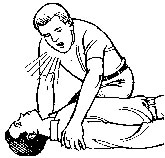
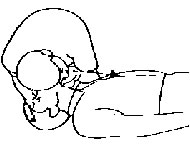
Figure 1
- PREPARATION: We will position ourselves at shoulder height, we will remove the clothing that bothers us from the victim's chest (be careful with bras that have metal rings!); We will loosen the tie and belt, remove chains or necklaces and place the victim lying on a hard surface in a supine position (face up) with the arms along the body.
- BREATHING: We will evaluate it by bringing the side of our face closer to the victim's mouth and nose while we look at his chest and abdomen. With this we seek to hear and/or feel the entry and exit of the victim's air on our cheek, while allowing us to see and observe the respiratory movement of the thorax and abdomen. (fig. 2)
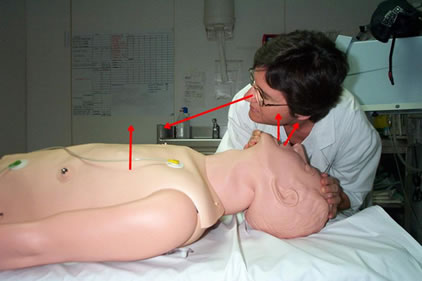
Figure 2.
If you do not feel breathing, we will observe that the mouth and pharynx are free of objects that could obstruct the airways (dentures, chewing gum, candy, phlegm, vomit, etc.), we will free the base of the tongue that can also obstruct the passage of air through the pharynx. To do this, we will put one hand on the forehead, which will push down, and the other on the back of the neck, which will pull up, thus managing to stretch the neck by raising the jaw and with it the base of the tongue, again checking breathing. . This maneuver is known as hyperextension.
If you do not feel breathing, we will observe that the mouth and pharynx are free of objects that could obstruct the airways (dentures, chewing gum, candy, phlegm, vomit, etc.), we will free the base of the tongue that can also obstruct the passage of air through the pharynx. To do this, we will put one hand on the forehead, which will push down, and the other on the back of the neck, which will pull up, thus managing to stretch the neck by raising the jaw and with it the base of the tongue, again checking breathing. . This maneuver is known as hyperextension.
.jpg)
- If breathing exists, we will turn the head to one side and proceed to perform the secondary assessment; If, on the other hand, breathing is not present, we will perform 2 consecutive insufflations ( mouth to mouth ) and then we will assess the pulse.
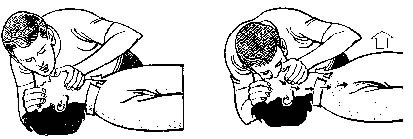
- MOUTH TO MOUTH: It consists of introducing the air contained in our mouth, pharynx, larynx, trachea and bronchi into the victim's lungs before it becomes vitiated by our own breathing; That is to say: the air that has not yet undergone total gas exchange in our lungs.
- To do this, keeping the victim's neck extended, we will stick our lips tightly around the victim's mouth while we pinch his nose with the index fingers and thumb of the hand that we keep on his forehead; We will blow air into him with moderate force for no more than two seconds while looking at his thorax and abdomen and making sure that what rises is the thorax.
- If when insufflating we see the abdomen rise, it is a sign that the air passes to the stomach instead of the lungs; In this case we will correct the posture of the head by hyperextending the neck again or by checking the cavity of the mouth and pharynx again to detect that the tongue or foreign bodies prevent the entry of air into the lungs.
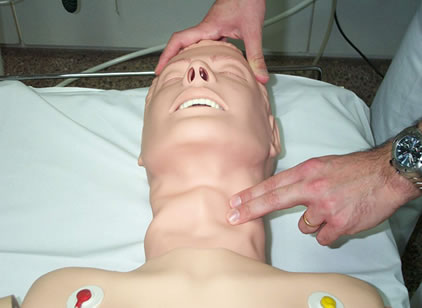
- PULSE: We will locate the pulse in any of the carotid arteries located in the neck on both sides of the apple. To do this, we will use 2 or 3 fingers (never the thumb) of the hand that we had on the back of our neck, which we will make slide along any of the sides of the trachea (preferably on the opposite side to us) until the depression between it and the external-cleido-mastoid muscles, pressing towards the apple.
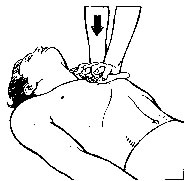
- PULSE: EXTERNAL CARDIAC MASSAGE: It consists of compressing the heart between the sternum and the spine, loading our weight on the lower third of the victim's sternum. To locate this point exactly, we will follow the lower edge of the ribs with the fingers of one of our hands in the direction of the sternum, and in the central area of the chest we will collide with the cartilaginous tip of the sternum (xiphoid process); At this point we will place 2 or 3 fingers of the other hand towards the head and at this new point we will place the heel of the first hand. This is the area where we will perform compressions, leaving you completely naked and especially if there are bras with metal rings.
- To do this, without resting either the palm of the hand or the fingers on the victim, we will place the other hand on the first (better intertwining the fingers) and with our arms straight and perpendicular to the victim's chest we will let our weight fall in order to to lower the thorax a few centimeters(1).
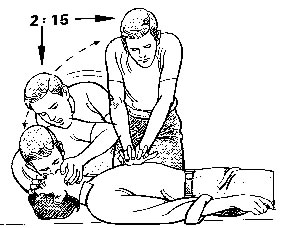
- The compressions will be dry and rhythmic (we will count...and one...and two...and three...etc.), in number of 15, later we will give two quick insufflations and again 15 external massages.
- Each set of 2 insufflations and 15 massages is called a rescuer resuscitation cycle.
- If there are two rescuers, the cycle is 2 insufflations and 30 massages.
- We will consider a sequence to be the set of 4 complete resuscitation cycles.
(1) ATTENTION: Not all people have the same consistency in their ribs, so it is recommended to quickly make one or two test pressures to determine the "hardness" of the dead stroke and know exactly where the real pressure on the heart muscle begins. .
- COMPLETION OF RESUSCITATION: At the end of each sequence we will reassess whether the pulse is present. If there is no pulse we will continue performing sequences until it returns. When the pulse returns we will reassess breathing acting as described above.
We will end the resuscitation...
- ...when another person replaces us (another lifeguard, ambulance personnel, doctor, etc.)
- ...when a doctor certifies the death of the victim
- ...when you regain vital signs or
- ...when we are exhausted and cannot continue resuscitation.